Florida's Milestone Inspection and SIRS Rules: What Every Miami Condo Buyer Needs to Know (2026)
How Florida's milestone inspections and structural reserve studies affect condo purchases: age triggers, local enforcement, applicable deadlines, reserve funding and the documents to review before buying.

On June 24, 2021, Champlain Towers South in Surfside collapsed and killed 98 people. The building had a 2018 engineering report identifying "major structural damage" to the pool deck slab, a $15 million repair estimate the board had spent three years arguing about, and reserves that owners had voted to waive for years. Every element of that story was legal at the time.
Florida subsequently changed its inspection and reserve requirements. These obligations can affect association budgets and assessments alongside insurance, maintenance and other costs. A buyer needs the actual building reports and financial documents to understand the effect on a particular purchase.
If you are buying a condo in Miami, this is the framework you're buying into. Here is how it actually works.
The Two Requirements
Florida's post-Surfside regime rests on two separate obligations, and buyers routinely confuse them.
1. The Milestone Inspection
A structural inspection by a licensed architect or engineer, required when a building reaches a certain age and every ten years afterward.
Who it applies to: buildings three habitable stories or taller that are subject, in whole or in part, to residential condominium or cooperative ownership, with statutory exceptions including certain one- through four-family dwellings. Confirm the building's classification and local requirements.
When it triggers:
- 30 years based on the certificate of occupancy is the general statewide trigger, followed by inspections every ten years.
- 25 years may apply when the local enforcement agency determines that local conditions, including proximity to salt water, require an earlier inspection. Current state law does not impose an automatic three-mile coastal test.
Ask for the local agency's notice, the certificate-of-occupancy date and any accepted prior inspection or extension. A marketing description of the construction year does not establish the inspection deadline.
How it works: in two phases.
- Phase 1 is a visual examination. The engineer walks the building, reviews what's accessible, and reports whether there are signs of "substantial structural deterioration."
- Phase 2 is triggered only if Phase 1 finds a problem. It's a substantive investigation -- destructive testing, core samples, load analysis -- and the association has 180 days from the Phase 1 report to file a progress report with a timeline for completing it.
Findings must be filed with the local building department and distributed to every unit owner. If Phase 2 finds deterioration, repairs become mandatory.
Miami-Dade's wrinkle: the county already had a 40-year recertification program before Surfside. The state milestone rule now sits alongside it. A building can find itself managing both the county's recertification cycle and the state's milestone cycle, and the two don't always line up.
2. The Structural Integrity Reserve Study (SIRS)
This is the part with the money in it.
A SIRS is an engineering-based reserve study that does two things: inspects the condition of specific structural components, and produces a funding plan showing how the association will pay to maintain and replace them over 30 years.
Who it applies to: residential condominium associations must obtain a SIRS at least every ten years for qualifying buildings with three or more habitable stories, subject to statutory exceptions and the components the association maintains. Cooperative associations have parallel requirements under a separate statute. The SIRS obligation is distinct from the age-triggered milestone inspection.
What it must cover -- eight categories, by statute:
- Roof
- Load-bearing walls and other primary structural members
- Fire protection systems
- Plumbing
- Electrical systems
- Waterproofing and exterior painting
- Windows and exterior doors
- Other qualifying items above the statutory cost threshold that would negatively affect those components. The $25,000 base threshold is subject to annual inflation adjustment; check the current threshold used in the study.
The deadline: for associations existing on or before July 1, 2022 and controlled by nondeveloper owners, the statute sets an initial December 31, 2025 deadline. Qualifying associations with a milestone inspection required by December 31, 2026 may coordinate the study with that inspection, with a December 31, 2026 limit for that coordinated completion. Separate statutory provisions address delays after qualifying inspections. Obtain the association's documented applicable deadline and have counsel review any claimed exception or delay; a missing study alone does not establish the same compliance conclusion for every building.
The Rule That Changed Everything: You Can No Longer Waive Reserves
For decades, Florida condo owners could vote to waive or reduce reserve contributions. Boards did it routinely to keep monthly fees low, and buyers rewarded them for it. Champlain Towers South had done exactly this.
For budgets adopted on or after December 31, 2024, ordinary votes to waive required SIRS-component reserves are restricted. The law also provides specific alternative funding arrangements and conditional pauses or reductions. Review the association's funding plan and the authority for any departure from regular contributions rather than assuming that every low contribution is unlawful.
This is the mechanism behind the fee increases. A building that had been contributing nothing toward a $12 million roof-and-waterproofing horizon suddenly has to fund that horizon, on a schedule, starting now. In older buildings with decades of deferred reserves, the jump has been severe -- and where the SIRS found work that needed doing immediately, the answer has been a special assessment on top of the higher fee.
The buildings on our list of Miami condos that have lost value since 2022 skew heavily toward older, large, investor-heavy towers. This law is a significant part of why.
What Changed in 2025 (HB 913)
The 2022 law was blunt, and by 2024 associations were struggling to comply. Engineers were booked out, the December 2024 deadline was unrealistic, and some buildings faced reserve requirements they could not fund without triggering mass owner defaults. House Bill 913, effective mid-2025, made several substantive adjustments:
The initial SIRS deadline moved to December 31, 2025 for the affected existing associations, with qualifying milestone coordination through December 31, 2026. The association's applicable requirements and any separate statutory delay need individual review.
"Three habitable stories" replaced the vaguer "three or more stories," and small buildings -- four-family dwellings with three or fewer habitable stories above ground -- were exempted.
Associations can now borrow to fund reserves. Loans, lines of credit, and special assessments are explicitly permitted as reserve funding mechanisms, with the appropriate board or member approval. This matters because it lets a building spread a large structural bill over time instead of hitting owners with it in a single assessment.
Conditional pauses and study timing. Current law separately addresses postponing a required study after a qualifying milestone or similar local inspection and temporarily pausing or reducing reserve contributions to fund recommended repairs. The contribution provision applies to eligible associations and budgets adopted on or before December 31, 2028, requires a majority of total voting interests, and is limited to two consecutive annual budgets. A study is required before contributions resume. These are conditional provisions, not an automatic exemption for every building that has had an inspection.
The funding plan must show a positive balance. A SIRS now has to include a baseline funding plan demonstrating that the reserve balance for all covered components stays above zero across the entire study period. No more plans that quietly go negative in year fourteen.
Conflict-of-interest disclosure. Ask for the study provider's required disclosures and any relationship with firms bidding on recommended work. The milestone-inspection statute also requires specified written disclosures about related repair-service bids.

What This Means for Fees, by Building Type
The impact is not evenly distributed, and understanding the pattern tells you what to expect in a given tower.
Newer buildings may be years from an age-triggered milestone inspection, but that does not establish their condition, reserve adequacy or future assessments. Review their applicable SIRS, budgets, insurance and maintenance obligations as well.
Buildings from the 2000s boom have different certificate-of-occupancy dates, local inspection requirements and funding histories. Do not assign an inspection deadline or assume a completed SIRS from the construction decade. Compare the actual reports, approved funding schedule and any planned work.
Older buildings can have substantial maintenance and replacement obligations, but their construction decade does not establish completed inspection cycles, a funding shortfall or an assessment amount. For an older tower in Aventura, Bal Harbour, Brickell Key or the barrier islands, examine its own engineering reports, repair history and funding documents.
We track fees per square foot across 212 buildings in our HOA fee ranking. A low fee in an older building is no longer a positive signal on its own -- it can mean the SIRS bill simply hasn't been folded into the budget yet.
The Documents to Demand Before You Buy
Florida requires sellers to provide certain association disclosures. Do not stop at what's required. Ask for all of the following, and treat a seller or association that can't produce them as having answered your question.
- The Milestone Inspection report -- Phase 1, and Phase 2 if required, together with the local agency's notice and documented applicable deadline, prior accepted inspection or extension.
- The SIRS -- the complete study, not a summary. Read the component condition assessments and the 30-year funding schedule.
- Current reserve balances against the SIRS schedule. Compare the balances with the approved funding plan and ask how any shortfall will be addressed, including the terms of any approved assessment or borrowing.
- The last three years of approved budgets. Watch the reserve contribution line. A sudden jump tells you when the building started complying.
- Any special assessment levied, approved, or under discussion. Get the last twelve months of board meeting minutes. Assessments are discussed long before they are approved.
- The master insurance policy and premium history. The other half of the fee-increase story.
- The estoppel letter at contract -- it will disclose approved assessments, but not ones still being debated, which is why the minutes matter.
- Engineering reports of any kind from the last ten years, whether or not they were called "milestone" reports.
If you're financing, understand that lenders read these too. A building with an open Phase 2 finding, an unfunded SIRS, or a pending assessment can be ineligible for conventional financing, which shrinks the buyer pool and hits resale value directly.
How to Read What You Find
A few interpretive rules that experienced Miami buyers use:
- A completed SIRS with a funded plan and a higher fee is the good outcome. The building did the work and priced it in. This is what you want to see.
- A completed SIRS with a low fee and no assessment deserves a hard second look. Either the building is genuinely in excellent shape, or the funding plan hasn't been adopted yet.
- No available SIRS requires an explanation supported by the association's applicable deadline and any statutory exception or delay. Have counsel assess compliance and the financial implications before proceeding.
- A pending assessment is not automatically disqualifying. A known, quantified bill for identified work is a negotiating point. An unquantified problem -- Phase 2 underway, no estimate yet -- is the situation to avoid, because you can't price it.
- Ask who's on the board and how long they've served. Buildings that got ahead of this had boards that started early. Buildings that didn't often had turnover, disputes, or a culture of keeping fees low at any cost.
What Sellers Should Know
If you own in a building that has completed its SIRS, funded reserves, and finished its structural work -- say so, prominently, in the listing. It is now a genuine selling point, and buyers who understand the law will pay for the certainty.
If you own in a building with an assessment pending, disclose it early and completely. Buyers who discover it late walk, and buyers who discover it late and feel misled tell other agents. The assessment will be priced into your sale either way; the only variable is whether it also costs you the deal.
Related Reading
- Miami Condo HOA Fees: 212 Buildings Ranked
- Which Miami Condo Buildings Lost Value Since 2022
- Miami Condo Price Per Square Foot: 210 Buildings Ranked
- Miami Condos That Allow Short-Term Rentals
Reviewed against the 2026 Florida Statutes on October 20, 2026. This is general information, not legal advice. Confirm the requirements, deadlines and documents applicable to a particular association with a Florida real estate attorney and the local enforcement agency.
Tags
Born and raised in Miami, Kyle Benjamin combines a background at Blackstone and Oppenheimer & Co. with hands-on coding and financial analysis. He founded REHUB Miami to make South Florida real estate easier to research through building comparisons, market data, floor plans, and local insights.
Read Kyle’s full bioRelated Articles
Miami Condo HOA Fees: 209 Buildings Ranked by Cost Per Square Foot
HOA fees range from $0.75 to $7.34 per square foot per month across Miami condo buildings -- a 10x spread that changes what you can afford far more than the purchase price does. Every building with enough listings to measure, ranked.
Is Pre-Construction in Miami a Good Investment? What the Numbers Show (2026)
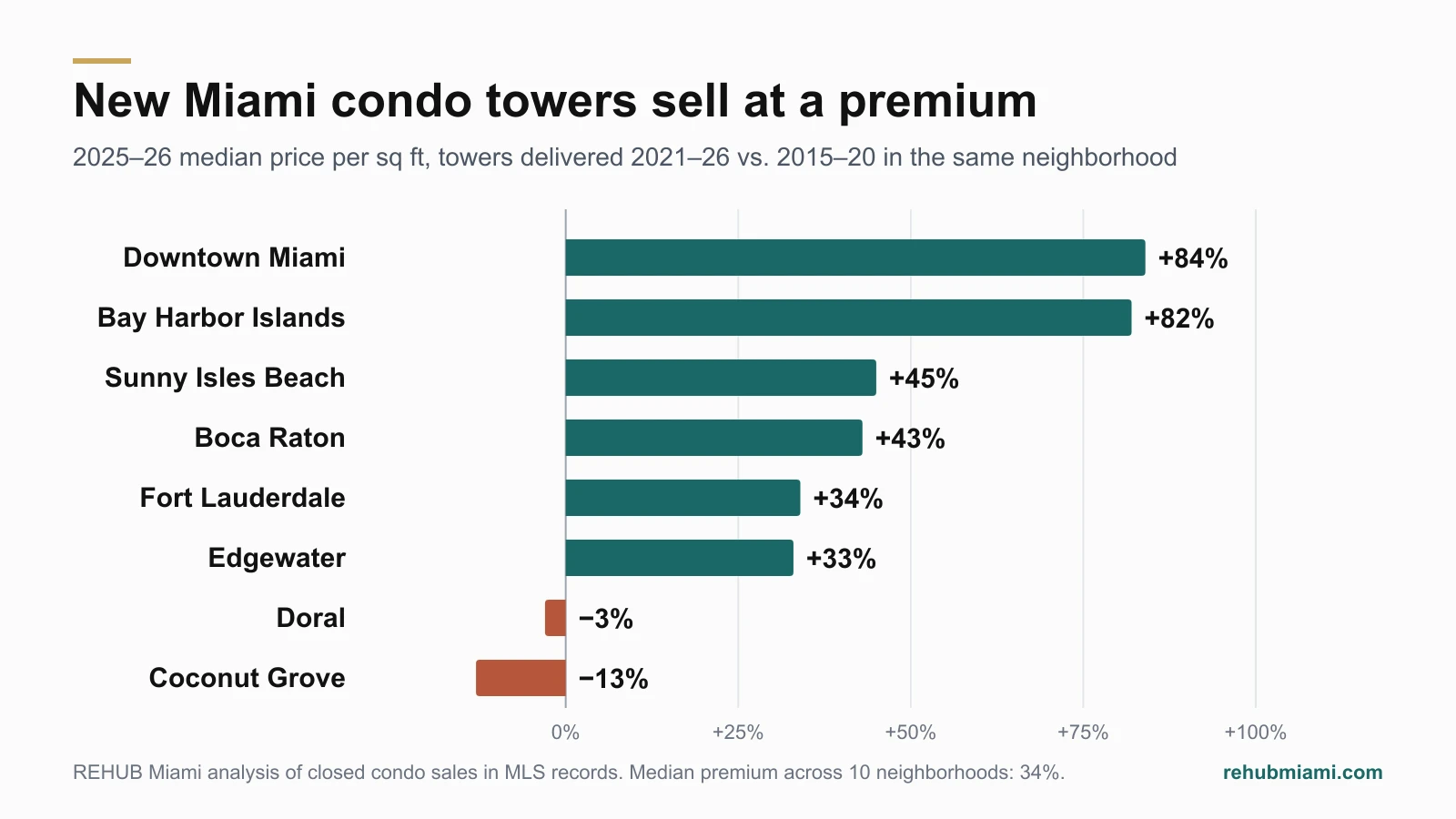
Brand-new Miami condo towers sold for a median 34% more per square foot in 2025–26 than towers built just five to ten years earlier in the same neighborhood. That newness premium is what a pre-construction buyer is positioned to capture, and our analysis of 41,000 sales shows it fades after delivery. Here is when pre-construction pays, what a deposit really earns, and the risks to weigh.
Miami Condos That Allow Airbnb and Short-Term Rentals (2026 List)
Which Miami condos allow Airbnb? A neighborhood-by-neighborhood list of 230+ Miami-area condo buildings sorted by the shortest stay each one allows, nightly, monthly or three months and up, checked against MLS lease records and linked to live listings, plus the zoning, lender and board rules that decide whether the income works.